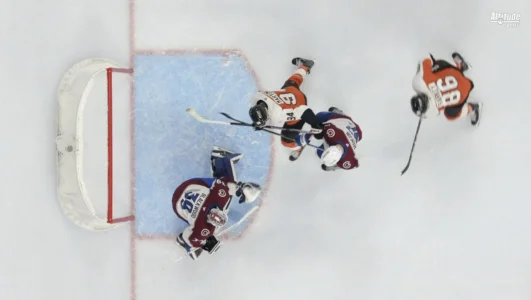

Matvei Michkov's goal survived Jared Bednar's goalie interference challenge Monday night, bringing the NHL's controversial review standards back into the spotlight.
The Colorado Avalanche challenged the Philadelphia Flyers' opening-period goal, believing there was enough contact around the crease to overturn the call.
After video review, the officials upheld the goal.
Michkov's power-play marker came at 7:41 of the first period, with Denver Barkey and Trevor Zegras collecting assists.
What should've been a straightforward scoring play immediately became another debate about officiating consistency.
The overhead replay showed bodies converging around the blue paint, with Michkov positioned near the Colorado net.
That sequence raised the familiar question of whether the goaltender had a fair opportunity to make the save.
Colorado didn't receive the ruling it wanted.
Worse, the unsuccessful challenge resulted in a delay-of-game penalty, leaving the Avalanche shorthanded immediately after conceding.
-
NHL officials under scrutiny for another interesting goaltender interference challenge in Avalanche vs. Flyers game
That's what makes these decisions so frustrating for coaches. They're asked to challenge plays under a rule that continues to generate arguments about what constitutes sufficient interference.
The issue isn't necessarily whether Michkov's goal deserved to count. It's whether the same standard would be applied to an identical sequence involving another team tomorrow night.
Goaltender interference remains among hockey's most subjective review decisions. Contact, positioning, defensive pressure and a goalie's ability to play the puck can all affect the outcome.
Yet the league's explanations haven't eliminated the frustration surrounding these rulings. Fans can watch similar-looking crease sequences and come away with completely different expectations about the decision.
For Bednar, the consequences were immediate. His team lost its challenge, the goal remained on the board, and Colorado faced another penalty.
For Rick Tocchet and the Flyers, the decision preserved Michkov's goal and rewarded Philadelphia's work around the net.
The bigger concern stretches beyond Monday's matchup. Every disputed ruling puts more pressure on the NHL to explain where incidental contact ends and interference begins.
Coaches deserve an understandable standard before risking another penalty. Fans deserve the same clarity when watching replays.
Until that happens, goalie interference challenges will remain a source of controversy, and Monday's decision gives critics another reason to question the NHL's consistency.
Has the NHL become too inconsistent with its goalie interference rulings?
Also read on Markerzone.com:
Emily Kaplan drops Connor Hellebuyck trade update from the Jets organizations perspective
